
If you’re eating healthy, exercising consistently, and still not losing weight, the real problem may not be calories at all. Scientific research shows that hidden factors—such as metabolic adaptation, chronic stress, sleep disruption, hormonal imbalance, fluid retention, and emotional triggers—can block weight loss even when your diet is “perfect.” This comprehensive guide reveals the underlying reasons and offers practical, expert-backed solutions to get results.
Introduction
If you’ve ever diligently tracked calories, gone to the gym, cut out sugar, or followed the latest trending diet—and still found the scale refusing to budge—you’re not alone. Millions of Americans report the same frustration every year. They push harder, restrict more, exercise longer, and still feel stuck.
The common assumption is that you must be “doing something wrong,” lacking discipline, or eating more than you realize. But that’s not the real story.
Modern health research reveals that weight loss resistance is influenced by far more than diet and exercise. Biological shifts, stress responses, sleep patterns, hidden calories, hormonal changes, and metabolic adaptation all impact fat loss in ways most people never consider.
In other words: It’s not your willpower. It’s your physiology.
This article breaks down the real reasons you’re not losing weight—and what you can do to finally see progress.
Why Weight Loss in the Real World Is More Complex Than Diet Culture Claims
For decades, weight loss advice revolved around a simplistic formula: eat less, move more. But emerging research demonstrates that weight management involves multiple interconnected systems. The National Institutes of Health reports that almost 48% of American adults attempt weight loss each year, yet sustained success remains low due to outdated, oversimplified strategies.
People are asking:
- “Why am I not losing weight even though I eat healthy?”
- “Why is my weight stuck despite working out?”
- “Is my metabolism damaged?”
- “Can stress make me gain weight?”
- “Why am I gaining weight while dieting?”
- “Is lack of sleep causing weight gain?”
These are not excuses—these are genuine biological questions that deserve answers. Let’s explore them in depth.
Reason #1: Your Metabolism Has Slowed Down (Metabolic Adaptation)
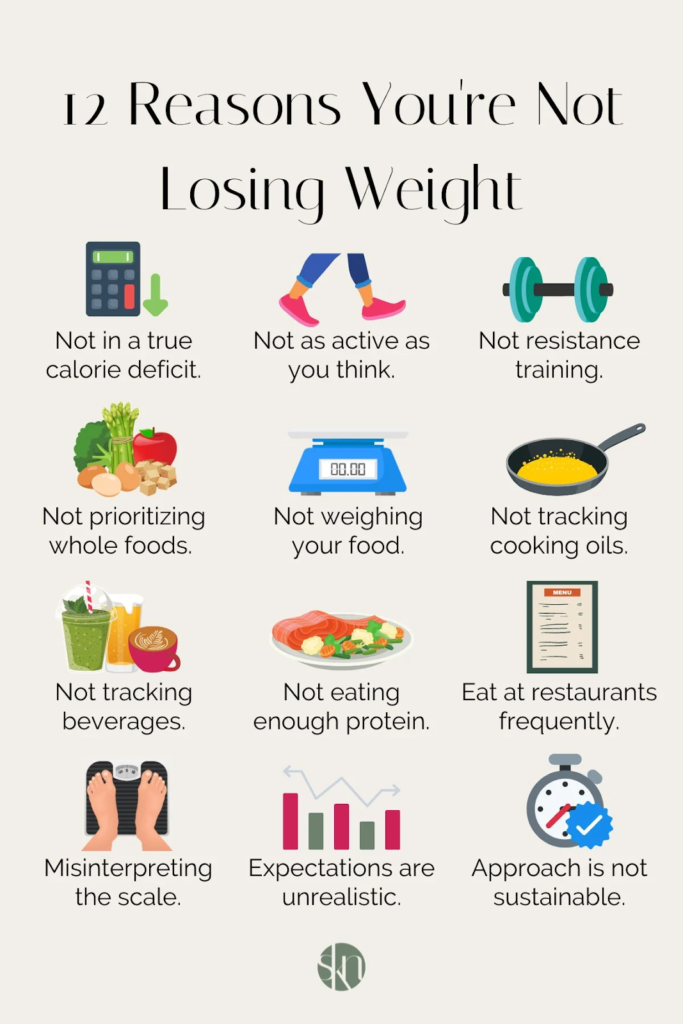
The biggest hidden cause of weight-loss plateaus is metabolic adaptation, sometimes referred to as “starvation mode.” When you reduce calories too aggressively or for too long, your metabolism slows down to conserve energy.
What happens in your body:
- Fewer calories burned at rest
- Decreased energy output
- Increased fat storage
- Hormonal shifts (lower leptin, higher ghrelin)
Real-Life Example
A 38-year-old woman from Dallas ate 1,200 calories daily for months. She lost weight initially, then completely plateaued for 10 weeks despite eating even less. When she increased her calories to 1,700 and added strength training three times weekly, her metabolism rebounded—and she began losing weight again.
Fix:
- Consume enough calories for your activity level
- Avoid extreme dieting
- Prioritize protein
- Strength train consistently
- Use calorie cycling instead of a constant deficit
Your metabolism thrives with balance—not restriction.
Reason #2: Chronic Stress Is Increasing Your Cortisol Levels
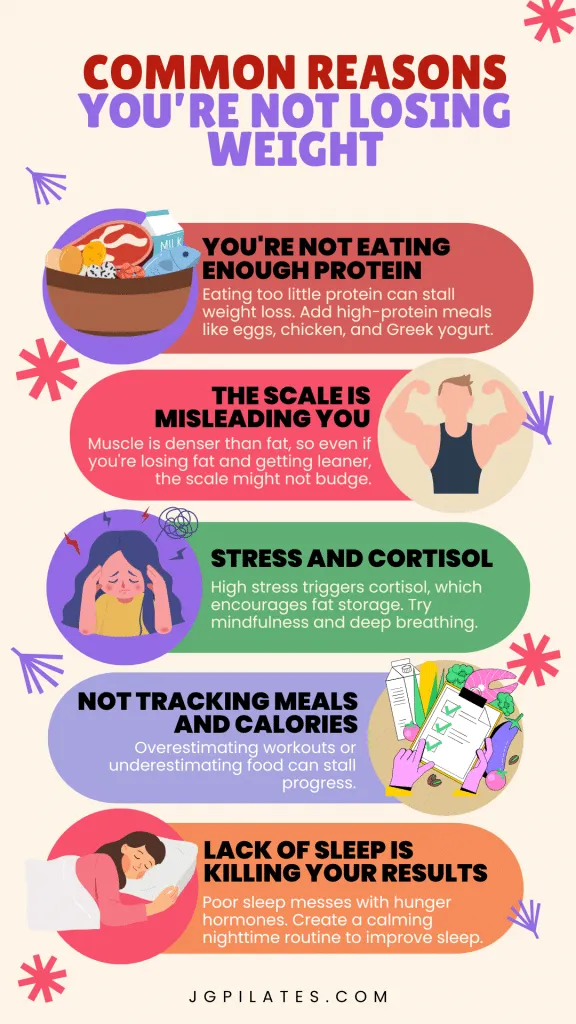
Stress may be the most underestimated contributor to weight retention. Elevated cortisol—your body’s stress hormone—can dramatically affect fat storage, especially around the midsection.
Chronic cortisol leads to:
- Higher cravings
- Increased appetite
- Blood sugar instability
- Stubborn belly fat
- Poor recovery
- Emotional eating
Real-Life Example
A 45-year-old business owner trained daily, ate well, and still couldn’t lose weight. Bloodwork showed high cortisol. Once she implemented stress-lowering routines (walks, meditation, sleep restructuring), she lost 11 pounds in eight weeks—without changing her diet.
Fix:
- Manage stress intentionally
- Walk daily
- Reduce high-intensity workouts
- Practice mindfulness
- Improve work-life boundaries
Weight loss is nearly impossible in a stressed-out body.
Reason #3: Poor Sleep Is Disrupting Your Weight-Loss Signals
Adults need 7–9 hours of sleep for optimal hormonal function. When you get less, your body enters a state that promotes weight gain—even if you’re dieting.
Lack of sleep causes:
- Higher ghrelin (hunger)
- Lower leptin (fullness)
- Slower metabolism
- Insulin resistance
- More cravings
- Worse decision-making
More than one-third of Americans are chronically sleep deprived. And many of them blame themselves for weight gain that is actually caused by hormonal imbalance.
Fix:
- Create a consistent sleep schedule
- Avoid screens before bed
- Keep your bedroom cool and dark
- Avoid heavy meals before bedtime
Sleep is the most undervalued fat-loss tool on the planet.
Reason #4: You’re Exercising Too Hard — or Not the Right Way
Working out more doesn’t always produce results. Too much high-intensity exercise can suppress metabolism and spike cortisol. Meanwhile, relying only on cardio can burn muscle and slow fat loss.
Signs of Overtraining
- Excessive soreness
- Fatigue
- Poor sleep
- Weight gain
- Bloating
- Water retention
Real-Life Example
A 44-year-old man did six HIIT workouts weekly. Instead of losing weight, he stalled. After reducing HIIT to twice a week and adding strength training and daily walking, he lost 14 pounds in two months.
Fix:
- Strength train 2–4x weekly
- Walk daily
- Limit HIIT to 1–2 sessions weekly
- Build in rest and mobility days
Weight loss requires strategic training—not punishment.
Reason #5: Hidden Calories Are Sneaking In Without You Noticing
You might be tracking meals—but are you tracking everything?
Most people forget to count:
- Sauces
- Oils
- Salad dressings
- Coffee creamers
- Smoothies
- Nuts
- Granola
- “Healthy” bars
These tiny additions can add up to an extra 300–500 calories per day, enough to stop weight loss entirely.
Fix:
Track your intake for 3–5 days. The awareness alone often breaks the plateau.
Reason #6: Hormonal Shifts Are Working Against You
Hormones regulate everything related to weight loss:
- Thyroid (metabolism)
- Estrogen (fat distribution)
- Testosterone (muscle mass)
- Insulin (blood sugar control)
- Cortisol (stress response)
- Leptin/ghrelin (hunger signals)
Imbalances in any of these can stall progress.
Real-Life Example
A 41-year-old woman gained weight despite eating in a deficit. Her blood test revealed low thyroid hormones and estrogen fluctuations. With medical support, her weight loss resumed.
Fix:
Request a hormone panel if you experience:
- Fatigue
- Irregular cycles
- Low libido
- Sudden weight gain
- Slow metabolism
Sometimes, biology—not behavior—is the barrier.
Reason #7: You’re Eating “Healthy,” But Not Eating for Weight Loss
Healthy eating and fat-loss eating are not the same thing.
Foods like:
- Smoothies
- Avocados
- Peanut butter
- Almonds
- Oatmeal
- Hummus
- Wraps
- Fruit juices
…are nutritious but calorie-dense.
Fix:
Build meals using:
- Protein first
- Vegetables second
- Carbs + fats last
Macro balance > food labels.
Reason #8: Emotional Eating Is Driving Your Behavior—Not Hunger
Emotional eating is one of the most common yet overlooked factors in weight loss resistance. You might eat due to:
- Stress
- Boredom
- Anxiety
- Loneliness
- Overwhelm
Over 60% of Americans report emotional triggers that influence food choices.
Fix:
- Practice mindful eating
- Use stress-breaker habits (short walk, deep breathing)
- Keep a food–mood journal
- Recognize emotional hunger vs physical hunger
Awareness is the first step toward progress.
Reason #9: You’re Not Drinking Enough Water to Support Fat Loss
Even mild dehydration slows metabolism, impairs digestion, and triggers unnecessary hunger.
Fix:
Aim for half your body weight in ounces of water daily, and more if you exercise frequently.
Water supports energy, digestion, and fat metabolism—yet most people drink far too little.
Top Questions Americans Ask About Weight Loss Right Now
Search engines reveal skyrocketing trends around:
- “Why am I not losing weight even with exercise?”
- “Is my metabolism damaged?”
- “Why do I lose weight slowly?”
- “Can hormones prevent weight loss?”
- “What is the best diet for fat loss?”
- “Why am I bloated all the time?”
- “How long should weight loss take?”
- “What is a realistic weekly weight loss goal?”
Below is a FAQ section answering these clearly and concisely.
10 Frequently Asked Questions (FAQs)
1. Why am I not losing weight even though I eat healthy?
Because weight loss depends on stress levels, sleep, hormones, and calories—not just food quality.
2. Does stress make weight loss harder?
Yes. Elevated cortisol increases belly-fat storage and appetite.
3. Is my metabolism damaged?
Not damaged—just adapted. It can be reset with proper nutrition and strength training.
4. Why does exercise make me gain weight sometimes?
Inflammation, muscle repair, water retention, and cortisol spikes can temporarily increase scale weight.
5. Can hormones stop weight loss?
Yes. Thyroid, estrogen, testosterone, insulin, and cortisol can all influence fat loss.
6. How much protein should I eat to lose weight?
Most adults benefit from 0.7–1.0 grams per pound of goal body weight.
7. Can poor sleep stall weight loss?
Absolutely. Lack of sleep disrupts hunger hormones and increases cravings.
8. What is the best exercise for fat loss?
Strength training + daily walking + moderate cardio creates the best long-term results.
9. How fast should I lose weight?
Healthy fat loss is 1–2 pounds per week, depending on starting point.
10. Do I need supplements to lose weight?
No—but vitamins D & B, magnesium, omega-3s, and protein powder can support metabolic health.
Final Takeaway
If you’re not losing weight, it’s not your fault—and it’s not about willpower.
Your body is responding to stress, hormones, sleep patterns, hidden calories, emotional triggers, and metabolic shifts. Once you understand and address these underlying factors, weight loss becomes smoother, more sustainable, and far more achievable.
You are not broken.
You are not failing.
You simply need a new strategy—one that works with your biology, not against it.